The Project Management Life Cycle
The Project Life Cycle
The project management life cycle provides a framework for managing any type of project.
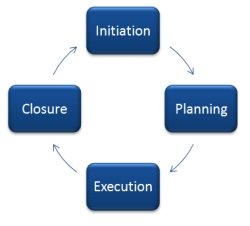 The Project Management Life Cycle
By definition, a project has a definite beginning and end. Between the beginning and end points, the project can be divided into four phases...
- Project Initiation
- Project Planning
- Project Execution
- Project Closure
Let's take a closer look at each phase of the project life cycle.
Project Initiation


The purpose of the Project Initiation Phase is to define and authorize the project.
The initial definition of the project can come from several places...
- Project Statement of Work (SoW)
- Business Case
- Contract
The project manager takes the information provided and creates a Project Charter. The Project Charter authorizes the project and documents the initial requirements for the project.
It generally includes information such as...
- Project purpose, vision, and mission
- Measurable objectives and success criteria
- High level project description, requirements, and risks
- Summary milestone schedule and budget
- Name and authority of the project sponsor
An important part of starting your project off right is performing a stakeholder analysis. Understanding which people or organizations will be impacted by or can influence your project is critical for ensuring your project's success.
Project Planning
The purpose of the Project Planning Phase is to determine the approach you will take and define all the details of how the project will be done.
Project Planning has two parts...
- Strategic Planning
- Implementation Planning.
During Strategic Planning you develop the overall approach to the project. During Implementation Planning you figure out all the details of how the project will be done.
A good way to visualize this is to think of your project as a family vacation.
- During Project Initiation you determine where you want to go (your mission).
- During Strategic Planning, you decide whether you want to fly there or drive (your approach).
- Let's say you decide to drive. In that case, during Implementation Planning you would map out your route, identify which hotels you will stay at along the way, determine how long each leg of the trip will take, and so on (all the details).
Project Execution
The purpose of the Project Execution Phase is to carryout the activities defined during the Project Planning Phase.
Project Execution is where most of the time, money, and people are used on a project. This is where the action takes place.
During this phase of the project management life cycle the project manager has to keep all the activities moving forward in a coordinated manner. This means you will need to track the progress of each activity and adjust your plans when the situation changes. This tracking and adjustment of project activities is also known as Monitor and Control.
During the execution phase all of the agreed project deliverables should be implemented and accepted by the customer. The customer can be an internal customer or an external customer.
Project Closure
The purpose of the Project Closure Phase is to formally close the project.
During Project Closure, there are several key activities that need to be performed...
- Verify that the completion criteria are met
- Create a project closure report
- Collect and archive project artifacts
- Perform a project postmortem
Many projects skip this phase. Once the Execution Phase is complete, they simply move on. It's unfortunate since they really don't know if the project objectives have been met, don't organize the project artifacts to be easily found for future project's reference, and don't identify the key issues and lessons learned by the project that can be applied to future projects.
Performing Project Closure will benefit both your company and your career. If you do this well, you will set yourself up to lead high-visibility, business-critical projects. So make sure your projects go through the full project management life cycle.
Related Articles About The Project Management Life Cycle
These project management principles will help you build a strong foundation from which to manage your projects. Learn how you can use these fundamentals to ensure your projects succeed.
What is Project Management?
What is project management? Going beyond your typical definition of project management, find out why project management is exhilarating, challenging, and inspiring.
Project Manager Duties and Responsibilities
Understanding key project manager duties will help you lead your projects successfully. Using the four functions of management, learn about the main responsibilities and duties of a project manager.
Avoid Project Management Failure: Tips for Achieving Project Success
Do you want to avoid project management failure? Learn three critical tips that will significantly increase your ability to achieve project management success.
Organizational Structure Types for Project Managers
Learn how organizational structure types can affect how you manage your project.
Do You Want More Project Management Tips?
Subscribe to Project Success Tips, my FREE Project Management Newsletter where I share tips and techniques that you can use to get your Project Management Career off to a great start.
As a BONUS for signing up, you'll receive access to my Subscribers Only Download Page! This is where you can download my "Become A Project Manager Checklist" and other project management templates.
Don't wait...
New! Comments
Have your say about what you just read! Leave me a comment in the box below.