A Definition of Communication for Project Managers
Why Understand a Communication Model?
Good communication skills are essential for project managers.
Using a simple model or definition of communication as your starting point can help you communicate more effectively.
Using a communication model can help you in two ways...
Planning Communications
A communication model will help you prepare your communications so that they have a better chance of being received, understood as intended, and then acted upon by the receiver appropriately.
Fixing Communication Problems
A communication model will provide you with a framework that you can use to figure out where communication breakdowns are happening and help you determine what steps are needed to correct them.
A Practical Communication Model
A Practical Definition of Communication
The act of transferring information from one person to another for some desired effect.
Aristotle is thought to have developed the first model of communication. This model is a direct match with the above definition. It consisted of three parts: the Sender, the Message, and the Receiver.
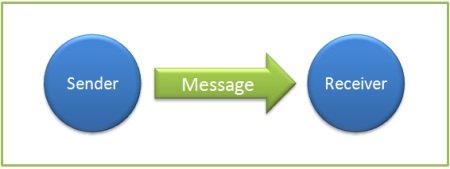 Aristotle's Communication Model
Since Aristotle's time, more communication models have been developed. The communication model below incorporates elements from several of these other models.
As with Aristotle's model, you have a Sender, a Message, and a Receiver. But a few more elements are needed to make it useful for us as Project Managers. Here are all of the elements and their role in the model.
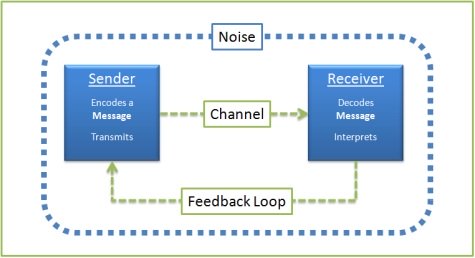 A Communication Model for Project Managers
The Sender
The Sender has information that he wants to share with someone else, usually for some intended purpose. The Sender is responsible for "encoding" the information into a message and then transmitting it.
Encoding the information usually entails putting his thoughts into words and then transmitting those words by speaking them, typing them into an email and sending it, and so on. But it could also involve non-verbal communication.
The REceiver
The Receiver is the intended target of the message sent by the Sender. The Receiver is responsible for "decoding" the message and interpreting it.
It's important to be aware of the Receiver's environment. For example, what are their experiences, language capabilities, and goals? If the Receiver is one of your project stakeholders, make sure to include them in your Stakeholder Analysis.
The Message
The Message is the encoded information the Sender wants to share with the Receiver.
The Channel
The Channel is the communication medium the Sender uses to transmit the message to the Receiver. Some examples of the different types of communication medium are...
- Face-to-face communication
- Video conferencing
- Telephone
The Feedback Loop
The Feedback Loop is how the Sender interprets the Receivers response to his message. Did the message have the desired effect on the Receiver?
Noise
Noise refers to any interference to the message traveling along the Channel or in the decoding and interpretation by the Receiver. For example, if communicating via mobile phone and the line isn't clear, your intended message may not be received correctly. Another example is if you send a message in English to a non-native English speaker, an uncommon word or phrase may get interpreted incorrectly.
Using the Communication Model in Project Management
Now that you understand the different elements of this Communication Model, let's take a look at how you can use it to communicate more effectively.
When planning your communications, use the model as a guide.
- Determine the purpose of your communication. Do you expect some specific action from the Receiver?
- Choose an appropriate Channel for sending your message. Email may be appropriate for certain communications whereas face-to-face is better in other situations.
- Using the Feedback Loop, make sure your message was received, interpreted, and acted upon as intended.
The communication model is especially useful for diagnosing communication problems. For example...
- If the Receiver didn't receive your message, check to see what Noise could have interrupted the transmission of the message.
- If the Receiver didn't interpret or understand your message correctly, check to see how you encoded it. Maybe you used jargon not fully understood by the Receiver, or maybe you just need to improve your writing or speaking.
In Conclusion...
Using this practical definition of communication along with a communication model can help you develop effective business communication skills.
Related Articles About The Definition of Communication
The Importance of Communication Skills in Project Management
Understanding the importance of communication in business is critical for project success. Get a practical definition of communication and learn about the different types of communication you can use.
Different Types of Communication for Effective Project Management
Effective communication skills are the foundation of a project manager's success. Learn how using four different types of communication can help your project get results.
Effective Communication in the Workplace - Get Business Results!
Effective communication in the workplace is required for successful project management. Here are four guidelines to help you provide effective business communication to your project stakeholders.
Types of Communication Medium: Business Communication Media for Project Managers
Strategically choosing the types of communication medium you use will help you communicate successfully. Learn the factors to consider when determining which business communication media to use.
Do You Want More Project Management Tips?
Subscribe to Project Success Tips, my FREE Project Management Newsletter where I share tips and techniques that you can use to get your Project Management Career off to a great start.
As a BONUS for signing up, you'll receive access to my Subscribers Only Download Page! This is where you can download my "Become A Project Manager Checklist" and other project management templates.
Don't wait...
New! Comments
Have your say about what you just read! Leave me a comment in the box below.